No Curtain, No Distance: The Companies Staging Theatre in Britain's Most Unlikely Rooms
Let's talk about a toilet.
Specifically, let's talk about sitting on one — lid down, obviously, we're not animals — while a performer stands in the doorway of a two-metre-square bathroom in a Bradford terraced house and delivers a fifteen-minute monologue about her grandmother's immigration from Jamaica in the 1960s. There are four audience members. You are one of them. You are close enough to see her hands shaking. You are close enough that when she pauses and looks directly at you, there is absolutely nowhere to redirect your gaze.
This is not a hypothetical. This happened. People who were there still talk about it years later in the specific hushed tone reserved for experiences that rearranged something in them.
This is what theatre in genuinely intimate, genuinely unexpected spaces can do — and a growing number of UK companies have made it their entire reason for existing.
Why the Room Matters
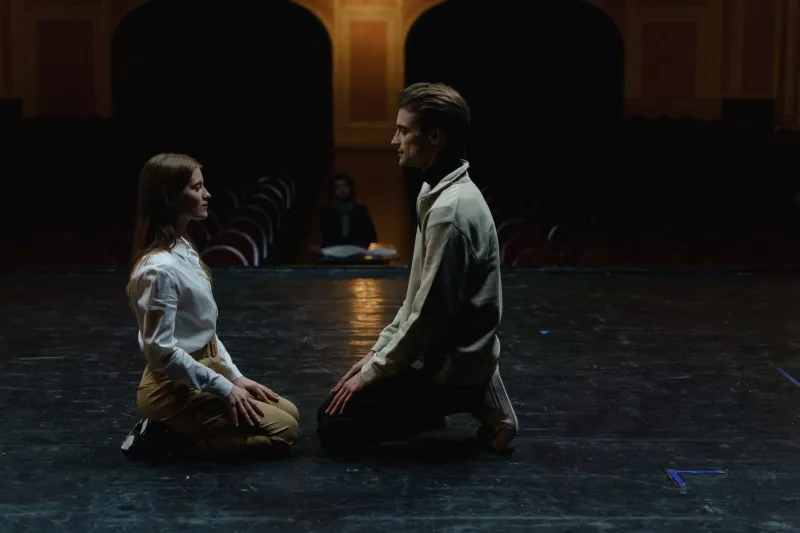
Conventional theatre venues do a lot of invisible work to keep audiences comfortable. The darkness helps. The distance helps. The rows of seats create a social contract: you are here to watch, the performers are there to be watched, and the physical architecture of the building reinforces this at every turn.
Strip all of that away and something interesting happens. The relationship between performer and audience stops being a transaction and starts being — there's no softer word for it — an encounter.
"Conventional theatre spaces are brilliant at a lot of things," says one London-based director who has staged work in a disused betting shop, a working laundrette in Peckham, and a GP surgery waiting room in Leeds. "But one thing they're very good at is letting audiences stay in their heads. You can intellectually appreciate a performance from twenty rows back in a way that keeps you fundamentally safe. That's fine for some work. But some stories need to get under your skin, and for that, you need proximity."
Her laundrette piece — a two-hander about two strangers waiting for their wash cycles to finish, performed among actual functioning machines with actual strangers doing their actual laundry — was staged without any announcement to the public. Customers came in, realised something was happening, and made a choice about whether to stay. Most stayed. Several came back the following week having told friends.
"The best response I got was from a bloke who said he wasn't sure for the first ten minutes whether it was real or not," she laughs. "That uncertainty — that's the most exciting theatrical space there is."
A Guide to the Spaces (and What to Expect)
If you're new to this kind of work, knowing what you might be walking into is genuinely useful. Not because you need to steel yourself — though occasionally you might — but because understanding the logic of a space helps you get more out of what happens inside it.
Domestic spaces (living rooms, kitchens, bathrooms) create an immediate intimacy that's hard to manufacture anywhere else. You're in someone's home, or a space designed to feel like one. Your body knows the codes of behaviour in these rooms — be quiet, be polite, don't take up too much space — and good theatre-makers exploit that knowledge brilliantly, creating work that plays with your instincts about how to behave in private versus public.
Waiting rooms and institutional spaces (hospitals, job centres, solicitors' offices) carry a weight of collective anxiety that performers can tap into without a single word of dialogue. If you've ever sat in an NHS waiting room, you already understand something about vulnerability and powerlessness and the strange intimacy of sharing difficult moments with strangers. Theatre made in these spaces doesn't have to explain any of that. It just has to point at it.
Working commercial spaces (laundrettes, cafés, markets) offer the extraordinary possibility of genuine ambiguity. Is this performance or is this life? That question, held for even a few minutes, changes how you see everything around you — and that perceptual shift is itself a kind of theatre.
Outdoor-adjacent intimate spaces (stairwells, car boot interiors, allotment sheds) create a sense of the clandestine that's almost impossible to replicate in a conventional venue. When you've had to receive a text with a postcode and arrive at a specific time to be let in by someone who doesn't explain anything, you're already primed for something unusual before the work has even begun.
The Companies Doing It Best
Across the UK, a loose network of companies and independent artists are building serious bodies of work in this territory. They don't always know each other, and they're approaching the challenge from very different angles — but there's a shared instinct that the standard model of theatre venue is leaving something important on the table.
In Glasgow, a collective has been making work in the tenement flats of willing residents, with audiences of no more than six people at a time. Their current project involves performers who are also actual neighbours of the buildings they perform in, blurring autobiography and fiction in ways that become genuinely vertiginous in such close quarters.
In Cardiff, one company has taken over a different chip shop each month for the past year, staging short pieces that respond to the specific history and neighbourhood of each location. The chips, apparently, are excellent. The theatre, by all accounts, is better.
In east London, a solo artist has been performing in her own bathroom for ticketed audiences of one person at a time. Each performance is thirty minutes. Each is different. She describes it as "the most frightening and most honest work I've ever made" — and there is currently a six-month waiting list.
On Being Uncomfortable
Here's the bit that needs saying plainly: some of this work is going to make you physically uncomfortable. Cramped spaces, odd sightlines, nowhere to put your bag, nowhere to look when the emotional temperature rises. That's not a bug. That's the whole architecture of the experience.
Discomfort, when it's thoughtfully deployed, is one of the most powerful tools theatre has. It keeps you present. It makes you aware of your own body, your own responses, your own instinct to look away or lean in. And when you're that aware of yourself, you're also — paradoxically — more open to what's being offered.
The distance that conventional theatre spaces provide is comfortable. But comfort, in theatre as in life, has a habit of keeping you exactly where you already are.
The companies working in Britain's strange, forgotten, gloriously unsuitable rooms are betting that you'd rather be somewhere else entirely — somewhere that asks something of you, somewhere that leaves a mark. Based on the waiting lists, the word-of-mouth, and the people still talking about that bathroom in Bradford years later, it looks like they're right.