Your Mouth Is Part of the Show: How British Theatre Learned to Love the Heckle
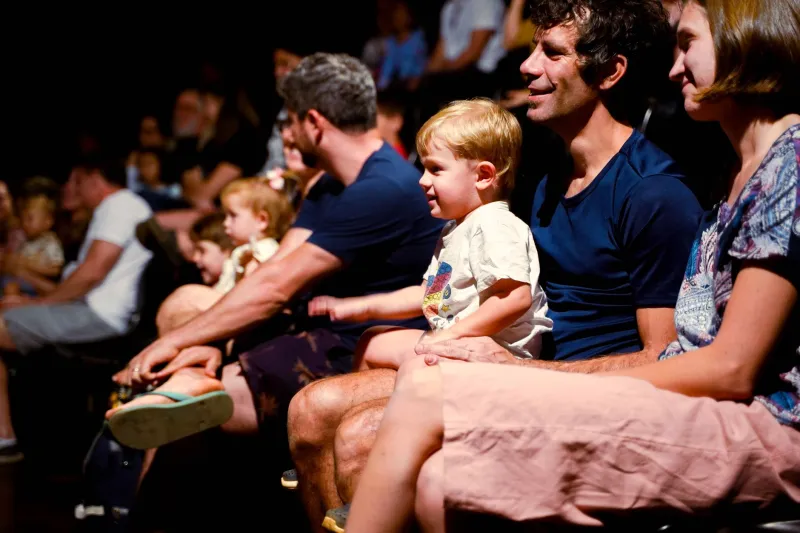
There's a particular kind of tension that settles over a traditional theatre audience. You know the one. Shoulders pulled in, programmes clutched like shields, a collective agreement — unspoken but ironclad — that whatever happens on that stage, you will receive it in respectful, grateful silence. You will clap when instructed. You will not eat loudly. You will absolutely, under no circumstances, say anything back.
That compact is crumbling. And some of the most exciting theatre makers in Britain are the ones doing the crumbling.
Across the country, from converted warehouses in Manchester to pop-up spaces in Bristol and back-room stages in south-east London, a growing cluster of experimental companies are doing something that would have horrified a drama school tutor fifteen years ago: they're actively inviting their audiences to talk back. Not politely. Not in a structured Q&A after the curtain call. During. In the middle of it all. At the precise moment when something uncomfortable is happening on stage and you feel that familiar social pressure to stay quiet.
They want you to open your mouth. They're counting on it.
The Heckling Tradition Nobody Talks About
Here's the thing about heckling in British culture — it has a proud, if slightly chaotic, history that mainstream theatre has spent decades trying to pretend doesn't exist. Music hall thrived on it. Stand-up comedy was shaped by it. Political meetings were defined by it. The idea that an audience should simply absorb what's being offered, without friction or reply, is actually a relatively recent and rather bourgeois invention.
Experimental theatre, at its most honest, has always known this. The problem was that the infrastructure of theatre — the darkened room, the raised stage, the formal seating, the hushing ushers — was designed specifically to suppress it. You can have the most radical text in the world, but if your venue is telling bodies to be passive from the moment they walk through the door, you've already lost half the argument.
What's changed now is that companies are engineering around that infrastructure. Or dismantling it entirely.
Designing for Disruption
Take the approach being explored by several London-based collectives who've stopped thinking about audience interruption as a risk to be managed and started treating it as a dramaturgical tool. The logic is straightforward once you hear it: if your play is about power, complicity, or silence, then an audience that sits quietly and watches is already performing compliance. The form is undermining the content before a single word is spoken.
So you change the form.
One company — working out of a deliberately uncomfortable venue in Peckham — structures their shows with what they call 'friction points': moments where the action on stage becomes morally untenable enough that staying quiet feels like a choice the audience has to consciously make. They don't tell audiences this in advance. They don't hand out prompt cards. They just build the conditions and wait.
"The first time someone shouts something, the whole room changes," says their artistic director, who asked not to be named ahead of their upcoming production. "You can feel it. People sit up. They realise they're not just watching — they're in it. And once one person speaks, others realise they're allowed to."
Allowed to. That phrase is doing a lot of work. Because so much of the silence in traditional theatre spaces isn't about respect or engagement — it's about permission. Audiences have been trained, over generations, to understand that the stage is not for them. It belongs to the performers, the director, the playwright. Their job is consumption, not contribution.
The Philosophy Behind the Noise
This isn't just about making shows feel more lively or interactive in a vague, corporate team-building sort of way. The philosophical underpinning here is genuinely rigorous, drawing on a lineage that runs from Brecht's alienation effect through to Augusto Boal's Theatre of the Oppressed and into contemporary thinking about relational aesthetics.
Boal, in particular, is having something of a renaissance in British experimental circles. His concept of the 'spect-actor' — an audience member who is simultaneously spectator and actor, capable of intervening in the drama — maps almost perfectly onto what these companies are attempting. The difference is that where Boal's forum theatre was often explicitly pedagogical, today's practitioners are working in murkier, more aesthetically complex territory. They're not necessarily trying to teach you anything. They're trying to destabilise your certainty that watching is a neutral act.
Because it isn't. It never was. Every audience is already making choices — about where to look, what to laugh at, which characters to identify with. Making those choices audible, even argumentative, just makes the politics of spectatorship visible.
When It Goes Wrong (And Why That's Fine)
Let's be honest: it doesn't always work. Sometimes the heckle is crass, or derailing, or just one person who's had a few too many and wants to be the most interesting thing in the room. Companies working in this space are candid about the failures.
"We had a show last year where someone started a genuinely brilliant argument with one of our performers about halfway through," recalls one director based in Leeds. "And it was extraordinary for about four minutes. Then it became their show. We'd lost the thread entirely."
The skill, it turns out, is in building shows that can absorb interruption without collapsing — structures elastic enough to stretch around unexpected voices without snapping. That requires a different kind of rehearsal process, performers trained in improvisation and genuine ideological engagement with the material, and a willingness to accept that no two nights will be remotely the same.
For companies accustomed to the safety of a locked-down script and a predictable running time, that's a terrifying prospect. For the companies doing this work, it's the entire point.
What the Mainstream Is Missing
There's a reason this is happening in experimental spaces rather than on the stages of subsidised regional theatres or the West End, and it's not just about budget or risk appetite. It's about whose voices those institutions have historically been built to amplify.
A theatre that genuinely wants audience backtalk has to reckon with the fact that the backtalk might be critical. Might be angry. Might be directed at the institution itself, not just the fictional scenario on stage. The heckle, when it's working properly, is ungovernable. You can't invite genuine disruption and then curate which disruptions are welcome.
That's what makes it radical. Not the noise itself, but the surrender of control it represents — a theatre that trusts its audience enough to let them be difficult.
British experimental theatre has always been at its best when it's refusing to behave. Right now, it's inviting you to do the same.
So next time you're sitting in a small, slightly too-warm room somewhere, watching something that makes you want to say something — consider that your silence might be the most conventional choice you make all evening.